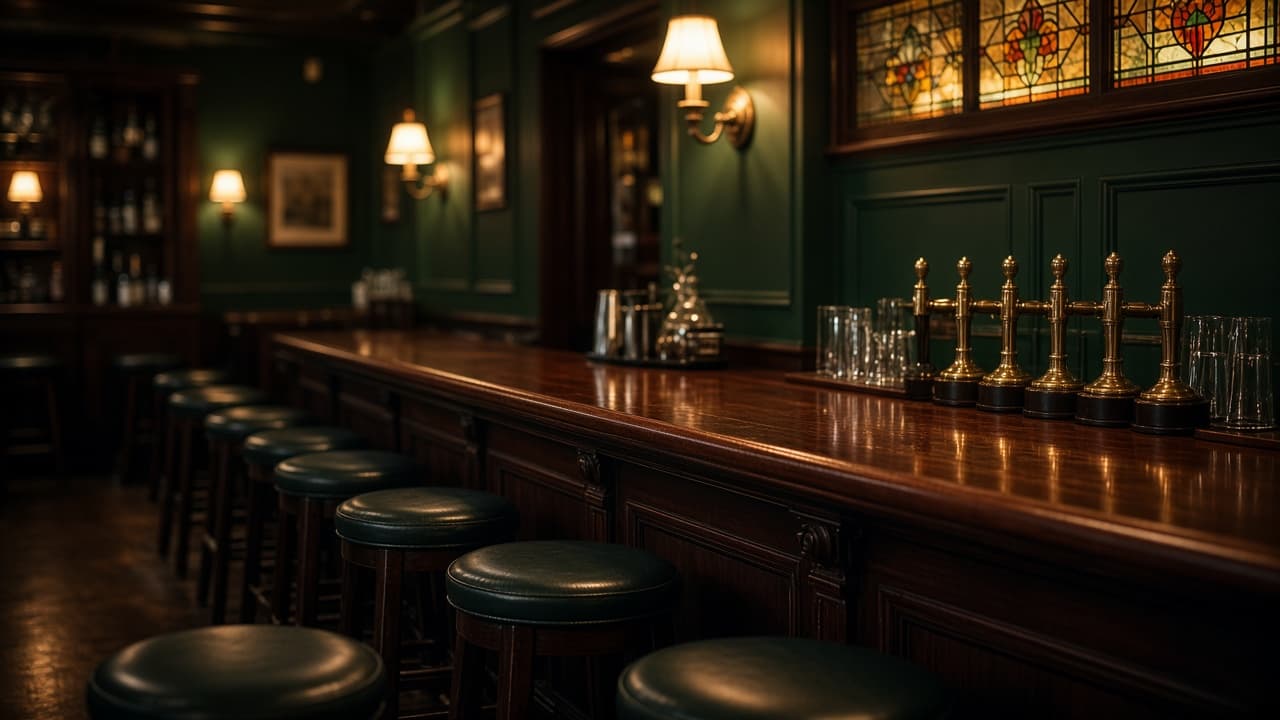
A pub is Irish in Australia when hospitality, conversation and music sit at the centre of the room, and when Irish drink and food are treated as ordinary rather than as a novelty. That is the whole answer, and it is enough to walk in with. The rest of this guide is how to recognise the thing, how rooms differ from city to city, and how to behave so you do not turn someone else’s regular night into a costume party.
The phrase “Irish pub” is used loosely here. It can mean a hotel that has kept a Gaelic sporting club’s after-match habit for decades. It can mean a purpose-fitted room with booths, a stout tap and a session night. It can mean a dining room that puts stew on the board and a fiddle in the corner on a Friday. None of those is automatically more authentic than the others. Authenticity, in a public house, is a practice. It is whether a stranger is made room for, whether a pint is poured as if the head matters, and whether the music — when it comes — is treated as part of the night rather than as a volume setting.
How the idea travelled
Irish people have been part of Australian life since the colonial period. Convict transports, famine-era arrivals, assisted migrants and later professional waves all left societies, parishes, sporting clubs and public rooms. The National Museum of Australia and the state libraries keep that record in letters, club minutes and photographs. Pubs were never the only Irish rooms — churches, halls and the Gaelic field were as important — but they were the rooms where talk and drink and a tune could sit together without a programme.
In the late twentieth century a more fitted version of the Irish pub also travelled, as it did in other countries: wood, brass, a framed map, a tap list that includes stout and a red ale. Some of those rooms became genuine locals. Some stayed as sets. A visitor cannot always tell from the door. The tell is inside. If the staff have time to finish a pour, if regulars can hold a corner, and if a visitor is greeted as a person rather than as a cover charge, the fitted room is doing the work. If every cue is for sale and the conversation is all instruction, you are in a display.
This guide does not name operators or rank rooms. Naming would turn a cultural note into an advertisement, and ranking would invent a score. What you can take into any city is a way of looking.
Reading a room
Stand for a minute before you commit to a stool. Look at whether people face each other or a screen. Look at whether the counter is a place to stand or only a queue. Listen for whether talk can survive the speakers. A pub can show sport and still be a pub; it stops being one when the screen is the only host.
Ask what is on tap that belongs to the tradition — a stout, a red ale, a cider — and whether there is a whiskey that is poured with a bit of care. You do not need a lecture. You need to know that the room treats those drinks as ordinary. If the only Irish cue is a poster, keep walking or stay for one drink and decide later.
Food is the other tell. A kitchen that will send out stew, soda bread or a cooked breakfast is speaking the same language as the bar. A kitchen that will only send nachos can still be a decent bar. It is just a thinner Irish room. There is no shame in that. There is only a mismatch if you came for the plate.
Music is the third tell. A booked band in the corner is one kind of night. A trad session is another. They are not interchangeable, and the sessions guide exists so you do not clap in the wrong place or sit in without asking. If there is no music, the room can still be Irish. Silence and talk are older than the PA.
City rooms and country rooms
Australian cities keep a range of Irish-styled rooms because Irish communities and visitors both asked for them. The city version is often louder, later, and more likely to run a session or a booked act. It is also more likely to be busy on 17 March in a way that has little to do with Patrick. If you want conversation that night, go early or choose a quieter suburb.
Country and regional hotels sometimes hold the older pattern: a public bar, a lounge, a dining room, and a function space that does funerals and twenty-firsts in the same week. Irish cues there may be light — a tap, a plate, a photograph — and the welcome may be stronger than the décor. Do not correct a room for failing to look like a brochure. If the fire is lit and the stew is on, you have the useful part.
Suburban rooms sit between those poles. Many are sports bars that remember they are Irish on particular nights. That is not a fraud if the night is kept well. It is a fraud if the shamrock comes out of a box only for a themed promotion and the rest of the year the room has no interest in the culture it is borrowing.
What to expect when you walk in
You can usually sit at the bar or take a table. If the room is tight, ask whether a table is held. Order at the counter unless you are told the table is waited. A stout takes longer than a lager. That is not incompetence. It is the settle. If you are in a hurry, order something that can be poured in one motion, or accept that you will wait.
Cash and cards both appear. Do not assume either. Water should be easy to get. If it is not, ask. Food orders in a busy room can lag; a good house will tell you. If you have an allergy or a need for a quieter seat, say so early. Pubs are public, not telepathic.
Courtesy is small and specific. Do not occupy a session chair with a coat. Do not film musicians without asking. Do not treat staff as entertainers. Leave the last seat at a four-top if a larger group is clearly gathering. If you are standing in a walkway with a pint, you are in the way.
What the phrase does not mean
It does not mean the owner must have been born in Ireland. Plenty of good rooms are kept by people who learned the habit rather than inherited it. It does not mean every drink must be imported. Local taps sit beside Irish ones in almost every Australian house, and that is ordinary. It does not mean the night must be loud. Some of the best hours in an Irish room are the late afternoon ones, when the light is still on the timber and the talk is not competing with a chorus.
It also does not mean the room is a museum of the nineteenth century. People watch football. People charge a phone. People order a soda and lime. A living pub absorbs the century it is in. What it should not absorb is contempt for the people who use it as a living room.
Courtesy, sport and language
Gaelic football and hurling still gather people in Australian rooms, especially when a county match is on at an hour that makes sense here. If you do not know the game, you can still watch. Ask a simple question if the room is friendly; do not perform ignorance as a joke. Rugby and the Australian codes appear just as often. An Irish pub is not obliged to show only one sport.
Language is another courtesy. A few words of Irish go a long way if they are used lightly and correctly, and they go nowhere if they are used as a party trick. English is the working language of almost every room. If you hear Irish spoken, it is usually among people who already share it. You can listen with pleasure. You do not need to join.
Nicknames, slagging and a certain speed of talk are part of some rooms and not others. Match the temperature you find. A visitor who arrives already performing “craic” can flatten the actual mood. Let the room set the pace.
Families, sobriety and who the room is for
Many Australian pubs can seat children in a dining room at ordinary hours and cannot do so in a late bar. That is a licensing fact, not a cultural one. If you are bringing a family, ask about the dining room and the last sitting. If you do not drink, you are still entitled to the room. Ask for a pot of tea, a soft drink, a coffee. A house that treats a non-drinker as a problem is a poor house.
People in recovery sometimes want the music and the talk without the pour. That is a reasonable want. Choose earlier hours, sit in the dining room if there is one, and leave when the night turns. You do not owe anyone an explanation.
How this sits beside the other guides
If you came for the feast day, St Patrick's Day is the next page. If you came for the plate and the pint, use food and drink. If you came with an instrument, or you want to know why a circle of players is not a concert, use sessions. If you are the person who has to ask for a room after a funeral or before a birthday, use functions.
The short test remains the one in the first sentence. Is the room organised around welcome, talk and a pint that is kept as if it matters? If yes, you are in an Irish pub in the only sense this guide is willing to defend. If no, enjoy the night for what it is, and do not force the word.