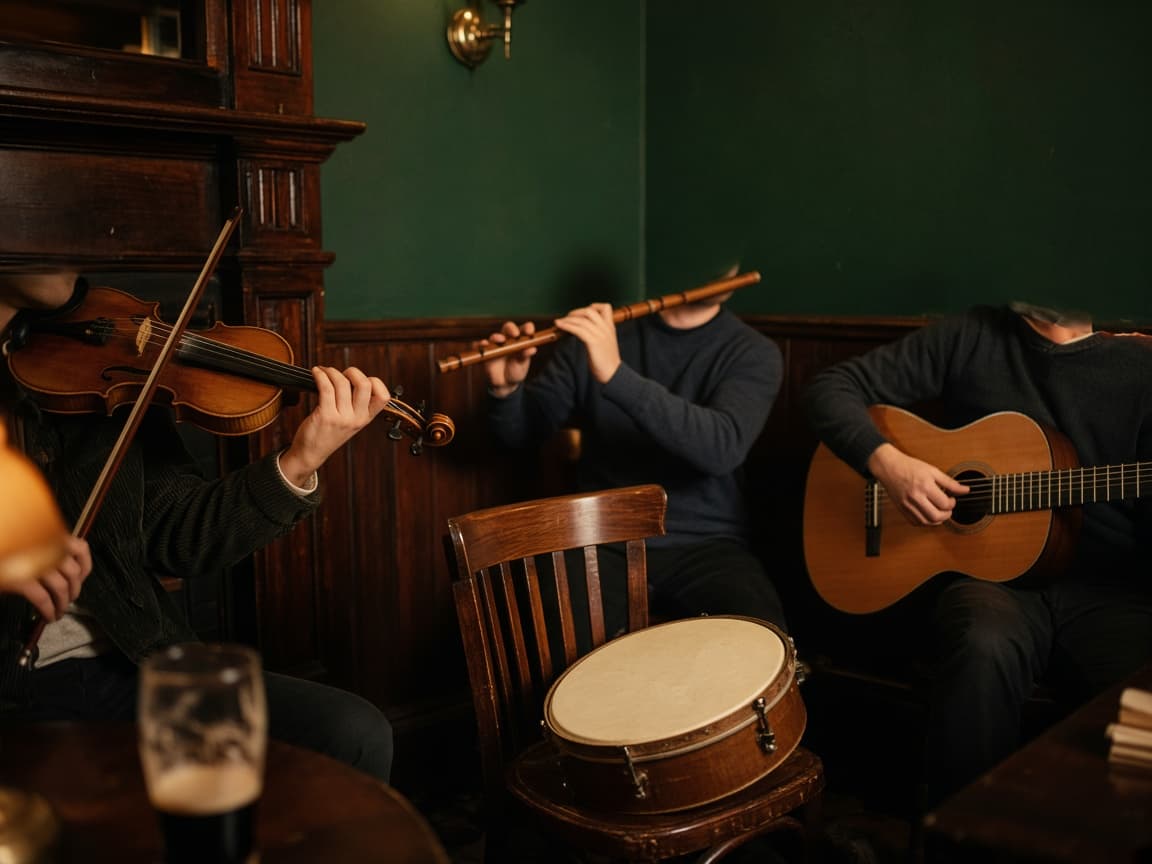
An Irish trad session is a shared circle of dance tunes and songs, not a concert. People sit with fiddles, flutes, concertinas, accordions, banjos, guitars and a bodhrán, and they play sets that the room already knows. To join, you arrive early, listen to a full set, catch a player’s eye and ask. If you are invited, you sit on the edge, play what you know, and you stop when you do not know the tune. That is the polite method in Ireland and it is the polite method in Australia.
A booked gig is a different night. Someone has been asked to play, there is a start time, and the room has been asked to listen. You can clap between songs. You should not treat the stage as a circle you can walk into with a guitar. This guide keeps the two nights apart so you do not spoil either.
What a session actually is
A session is informal and it is also rule-bound. The rules are social, not written. Someone — often an older player, sometimes just the person who got there first — sets the key and the tune. Others join when they know it. A set is usually two or three tunes in a row. Between sets there is talk, a drink, a retune. Songs can appear; they are not compulsory. Slow airs need more quiet than a reel.
The point is not to perform a solo. The point is to keep a tune walking so that dancers could, in theory, stand up. Most pub sessions have no dancers. The pulse should still be danceable. If you speed a reel until it is only a display, you have missed the room.
Instruments have habits. Melody instruments carry the tune. Accompaniment should be spare. A bodhrán player who plays every set at full volume is as unwelcome as a guitarist who strums through a slow air. If you play a loud instrument, you have a louder duty to listen.
Sheet music on a stand is rare in a pub circle and often a sign that the player has not learned the tune yet. Learning by ear is the older method. If you must glance at a phone, do it off to the side, not as a lectern in the middle of the table.
How an Australian session feels
Australian sessions live in pub corners, in halls, and sometimes in rooms that are Irish only on that night. They can be mixed: players born in Ireland, players who learned from parents, players who learned from recordings and from each other. That mix is ordinary here. What travels is the etiquette, not a passport.
Times vary. Some circles start in the afternoon. Some start after dinner. Some are announced; some are known by habit. This guide will not invent a weekly bill or name a host. If you want a session, ask a room that already keeps music, or ask a folk club, or listen for the tune as you walk past. Arrive for the start if you can. Walking in during a slow air with a case on your back is a poor entrance.
Volume in an Australian pub can be a fight. Speakers, fruit machines and sport will not always yield. A good house turns those down when the circle is in. A poor house treats the players as wallpaper. You can leave a poor house without a speech.
Listening well
If you are not playing, you are still in the session. Sit near enough to hear and far enough not to break the circle. Talk, but talk low. Save the chorus-shouting for a gig that asked for it. Clap at the end of a set, not between the tunes inside it. A whoop after a good reel is fine if the room is already that room. A speech about your holiday is not.
Do not film faces or hands without asking. A quiet recording for your own learning, if the players nod, is a different request. Put the request in a break, not over the tune.
Drinks for players are a kindness if they have been playing for a while and if you can do it without making a show. Ask rather than delivering a pint someone did not want. Water is always useful. Food is useful if the night is long.
Children who can sit and listen are welcome in many afternoon rooms and not in some late ones. Ask the house, not the fiddle.
Sitting in
Bring an instrument you can play in a pub. That sounds obvious. It means: you can keep a tune at session speed without stopping the set, and you can stop cleanly when you are lost. If you are not there yet, keep listening. A session is a poor first lesson and a very good fiftieth.
When you ask, ask one person, preferably someone who has already been leading. “Would it be all right if I sat in for a couple?” is enough. If the answer is a polite not-tonight, take it. The circle may be teaching, or recording, or simply full.
Sit at the edge. Tune off to the side, not into the microphone that is not there. When a tune starts that you know, join at a phrase boundary, not in the middle of a bar. Play under the lead, not over it. If you do not know the second tune in the set, stop. Tapping a foot is better than guessing the notes.
Songs: do not launch one unless you are asked, or unless the room has already opened that door and you have something that fits. A party chorus that flattens a quiet night is a theft. If you are asked to sing, sing one, then give the room back.
Harmonicas, pipes and other instruments that take a lot of air or a lot of space need even more asking. So does a full drum. The bodhrán is already a drum. Two is usually too many unless the players have agreed.
Gigs, open mics and the booked corner
A booked act is working. Give them the room you would give any working musician: a listen, a bit of quiet at the start of a song, and money if there is a hat or a door that was honestly described. Do not sit in. Do not request a tune as if the stage were a jukebox unless the act has invited requests.
Open mic nights are not trad sessions. They are a queue of turns. If you put your name down, play your turn and sit down. If a trad circle happens on the same night, the house should have said which is which. If it has not, ask before you unpack.
DJs and recorded playlists are another kind of night again. They can fill a dance floor. They are not a session. This guide will not review them. If you came for tunes, look at the corner, not at the speaker.
Tunes, keys and learning
Reels, jigs, hornpipes, polkas and slides are the dance forms you will hear most. A reel is in two; a jig feels in three. You do not need the theory to enjoy them. You need it if you are going to start one. Learn a handful of common tunes well rather than twenty badly. Players in Australia draw on the same shared stock you will hear on recordings from Ireland and from local teachers. There is no secret Australian key. There is only the key the person who started chose.
If you want to learn, find a class or a slower session first. Folk organisations and Irish cultural groups in the larger cities often keep them. This site will not name a teacher or invent a fee. Ask in a room after a night, or look to those groups directly.
The house, the neighbours and the end
Players are guests of the house even when they have been coming for years. Buy a drink or a meal if you can. Leave the table less wet than you found it. Stop when the staff ask. A session that argues with last orders is a session that may not be invited back.
Neighbours of a pub did not ask for a reel at midnight. If you are playing near a door or a beer garden, keep the volume at a human level. The tradition survived without amplifiers for a long time.
When you leave, leave. A long goodbye over a packed-up fiddle blocks the walkway. Say thanks to the person who made space for you. Come back when you have another tune, not only when you have another night to fill.
A last courtesy: if you start a tune, you are responsible for it until the set lands. That means choosing something the circle is likely to know, keeping the speed human, and nodding the change into the next tune so people can follow. If you cannot do those three things yet, let someone else start. There is no shame in that, and there is a lot of music still to hear.
If the gathering around the music is a birthday or a wake, take the questions in the functions guide as well. If you came for the pint that sits beside the tune, the food and drink page covers the pour. The room itself is described in Irish pubs in Australia. Keep the circle open, and keep your hands off a set you do not know.